


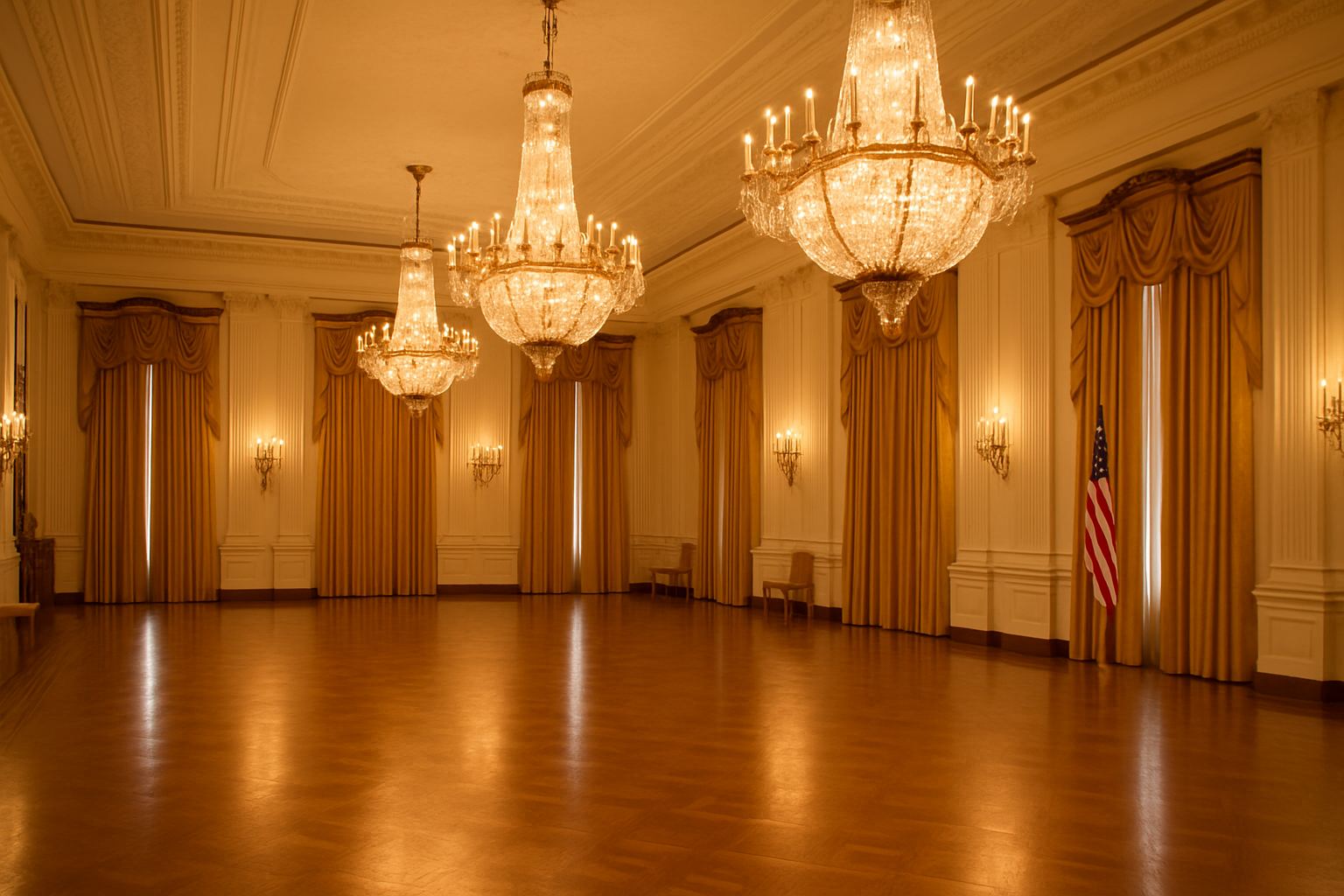
White House Ballroom: Where History, Elegance, and Power Collide
Some rooms hold echoes of laughter. Others, the whispers of diplomacy. The White House Ballroom holds both—wrapped in chandeliers and history.
The Beating Heart of the Nation’s Home
It’s easy to think of the White House as just a government building. But step inside the White House Ballroom and everything changes. You feel the weight of centuries. You smell the polished wood, the fresh florals, the history in the air.
Why is everyone suddenly talking about it again? Well, in the age of viral moments and press briefings turned fashion shows, the Ballroom has made an unexpected return to the spotlight. A recent State Dinner honoring world leaders went viral not for the speeches—but for the setting.
The gilded room stood shimmering behind the world’s most powerful people. And viewers asked: What is this place? Why does it feel like something out of a dream?
History Draped in Velvet
The White House East Room—often referred to as the Ballroom—isn’t just a ballroom. It’s a theater of diplomacy. It’s where Abraham Lincoln lay in state. Where Lyndon B. Johnson signed the Civil Rights Act. Where generations of presidents have toasted, danced, laughed, and mourned.
Originally designed by George Washington and completed under John Adams, the room has seen it all. Weddings. Funerals. Applause. Tears. It stretches 80 feet long, adorned with ivory walls, crystal chandeliers, and soft gold drapes. A room that’s both regal and hauntingly intimate.
But beyond its architecture, it’s the *moments* that breathe life into it.
Memorable Moments
- President Obama’s 2011 State Dinner for Chinese President Hu Jintao — a rare formal diplomatic feast.
- Jackie Kennedy’s iconic restoration of the room in the 1960s, adding neoclassical flourishes that still shine today.
- Countless concerts, from opera legends to modern stars like Beyoncé, echoing across its marble floors.
Why Now? The Ballroom’s New Spotlight
So, what brought the Ballroom back into the limelight? The answer is layered—much like the nation it serves.
First, the Biden administration has hosted more high-profile social and diplomatic events post-pandemic. These are often broadcast or photographed in the East Room—creating visually iconic moments shared globally.
Second, there’s been growing interest in American heritage spaces. A recent social media trend has spotlighted national architecture. The hashtag #WhiteHouseBallroom even trended after Jill Biden’s elegant hosting of the 2024 G7 welcome gala.
Architectural enthusiasts, history buffs, even wedding designers are suddenly swooning over the ballroom’s unique blend of Federal style and soft opulence. It’s classy, but not overdone. Grand, but not intimidating.
Voices From the Ballroom
Social media lit up after the recent G7 event. One user posted on X:
“The White House Ballroom looks like something out of a royal drama. America doesn’t often do elegance like this—but wow. Just wow.”
Another user on Threads wrote:
“Can we talk about how the Ballroom reflects who we want to be? Dignified. Welcoming. Timeless.”
Even former White House photographer Pete Souza shared a nostalgic shot of Michelle Obama dancing beneath one of the chandeliers, captioned simply: “Magic lives here.”
More Than Just a Pretty Room
But the magic isn’t just in the chandeliers or crown molding. It’s in what the room represents—**unity and ceremony** in a deeply divided world.
When foreign leaders step into that space, they’re greeted not just with protocol, but a message: This is America at its most gracious. Its most open. Its most hopeful.
The Ballroom has also become a place for internal healing. During COVID-19, it was used for award ceremonies honoring healthcare workers. It’s hosted art installations reflecting on racial justice and held conversations about the future of democracy.
It’s more than walls. It’s a stage—and each administration writes a new act.
What’s Next for the White House Ballroom?
There’s talk—quiet but persistent—about expanding access. The First Lady has hinted at using the Ballroom for public art exhibitions and possibly youth concerts. A modern twist on a traditional space.
Some are even lobbying for virtual tours with interactive storytelling, so Americans can digitally “walk through” the Ballroom and experience its stories firsthand.
Meanwhile, preservation teams are working to ensure that despite the foot traffic, age, and shifting administrations, the Ballroom stays as breathtaking as ever. There are plans for enhanced climate control, better lighting for events, and even new custom flooring that blends beauty with durability.
It’s a dance between past and future. And the music hasn’t stopped.
One Room. Infinite Stories.
In the end, the White House Ballroom isn’t just where power meets protocol. It’s where humanity shows up in its finest dress. Where silence sometimes says more than speeches. Where history dances between the walls and waits to meet its next guest.
And maybe, just maybe, that’s what keeps us watching.